Morph Genetics Explained: Why Some Crested Geckos Sell for $50… And Others for $5,000
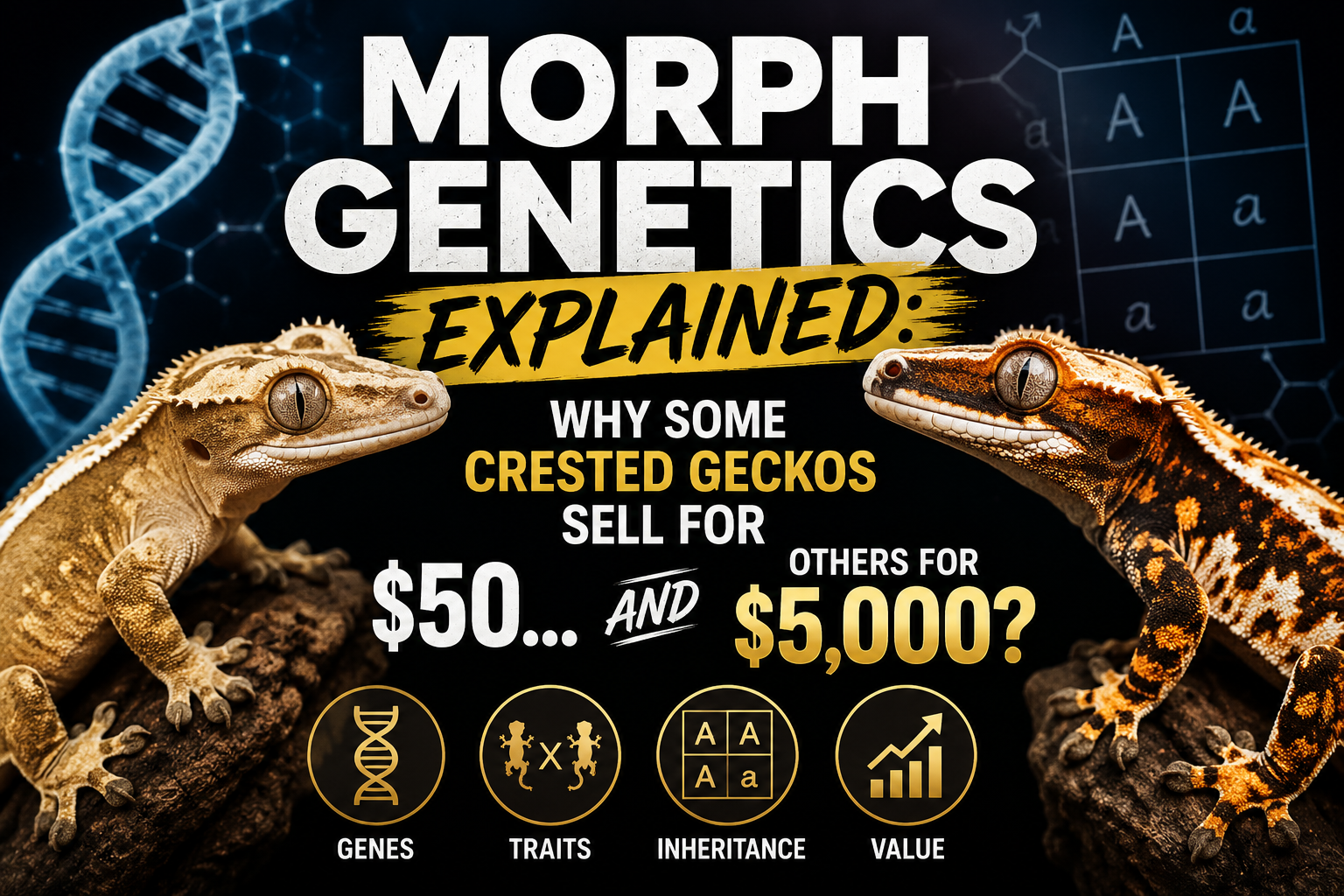
If you’ve ever looked at two crested geckos and wondered why one costs less than a pizza… while the other costs more than a used car payment…
You’re about to discover the answer.
And no — it’s not hype.
It’s genetics.
The truth is, most new crested gecko owners hear words like “heterozygous,” “polygenic,” “dominant,” and “line bred”…
…and their eyes glaze over faster than a gecko licking Pangea off a feeding ledge.
But here’s the deal:
You do NOT need a biology degree to understand morph genetics.
You just need someone to explain it in plain English.
So in this guide, we’re going to break down the mystery behind crested gecko morph genetics — without the scientific gobbledygook.
By the time you finish reading, you’ll understand:
- Why certain traits appear
- How breeders create high-end morphs
- Why some pairings are risky
- And how genetics affects price, rarity, and breeding potential
Let’s jump in.
What Are Crested Gecko Morph Genetics?
Crested gecko morph genetics refer to the inherited traits that determine a gecko’s color, pattern, structure, and overall appearance. These genetic traits are passed from parent geckos to their offspring through selective breeding.
Morphs such as flame, harlequin, pinstripe, dalmatian, and lily white are all the result of specific genetic combinations. Breeders study dominant, recessive, and polygenic traits to predict how baby geckos may look before they hatch.
Understanding morph genetics helps hobbyists choose breeding pairs responsibly and identify rare or desirable traits. It also allows keepers to better appreciate the incredible variety and beauty found within the crested gecko world.
At the most basic level, morph genetics determine:
- Color
- Pattern
- Contrast
- Striping
- Spots
- Cream coverage
- Overall appearance
In other words…
Genetics are the blueprint behind every morph you see.
That includes:
- Harlequins
- Flames
- Dalmatians
- Pinstripes
- Lilly Whites
- Axanthics
- Tiger morphs
- Quad Stripes
- If you’re still learning the basics, start with our Crested Gecko Morphs: The Complete Guide (2026).
Why Crested Gecko Genetics Confuse Beginners
Many beginners struggle with crested gecko genetics because morph combinations can look incredibly similar while carrying completely different traits. Terms like “partial pinstripe,” “harlequin,” “quad stripe,” and “Lilly White” often overlap visually, making it difficult for new keepers to identify what they actually own.
On top of that, genetics involve dominant, recessive, and polygenic traits that don’t always produce predictable offspring. Breeders also use different naming standards, which adds even more confusion.
Without understanding lineage, trait inheritance, and selective breeding, beginners can quickly feel overwhelmed trying to understand why two geckos can produce babies that look completely different from either parent.
Here’s where people get tripped up.
Many reptiles have:
- Dominant genes
- Recessive genes
- Predictable breeding outcomes
Crested geckos?
Not so much.
Most morph traits are considered:
Polygenic
That means multiple genes influence the final appearance.
Which explains why:
- Two Harlequins can look completely different
- Some Pinstripes have stronger lines
- Some Dalmatians have massive spotting
- Certain babies “improve” with age
This is also why breeders selectively pair geckos over many generations to strengthen desirable traits.
The Difference Between Line-Bred Traits and Genetic Traits
In the world of crested gecko morphs, line-bred traits and genetic traits are often confused, but they are very different. Genetic traits are inherited through specific genes and can be predictably passed to offspring, such as traits like Lilly White or Axanthic.
Line-bred traits, however, are developed over generations by selectively breeding geckos with desirable visual characteristics, such as brighter colors, stronger pattern contrast, or increased pinstriping. These traits are not tied to a single identifiable gene, making results less predictable.
While genetic morphs follow clearer inheritance patterns, line breeding relies heavily on selective pairing and patience to gradually enhance appearance over time.
Line-Bred Traits
Many morphs are improved through selective breeding over time.
Examples include:
- Extreme Harlequin
- Quad Stripe
- High-expression Tiger
- Super Dalmatian
Breeders repeatedly pair geckos with strong visual traits to “stack” those features into future generations.
Genetic Traits
Some morphs are more genetically distinct and predictable.
Examples:
- Lilly White
- Axanthic
These morphs are more heavily tied to inheritable genetic mutations.
- Compare these morphs in our [Lilly White vs Axanthic Comparison Guide] (internal link).
Understanding Common Morph Genetics
Understanding common morph genetics is essential for anyone interested in breeding or collecting crested geckos. Morph genetics determine the colors, patterns, and traits passed from parents to offspring. Traits such as pinstripe, harlequin, dalmatian, and lily white are influenced by dominant, recessive, or polygenic inheritance.
By learning how these genes interact, breeders can better predict hatchling outcomes and develop healthier, visually striking geckos. Genetics also help avoid problematic pairings that may lead to weak offspring or genetic defects.
Whether you are a beginner or experienced breeder, understanding morph genetics gives you greater control, confidence, and success in producing high-quality crested gecko morphs.
Let’s break down some of the most popular morphs.
Harlequin Genetics
Harlequins are known for:
- Heavy side patterning
- Cream coverage
- Leg markings
But here’s the catch:
Not all Harlequins are created equal.
Breeders selectively breed for:
- More cream
- Better contrast
- Cleaner patterns
Which eventually creates:
- Extreme Harlequins
- High-expression Harlequins
- See examples in our Harlequin Crested Gecko Guide
Pinstripe Genetics
Pinstripes are identified by raised cream scales running along the dorsal ridge.
But the quality varies massively.
Some geckos:
- Have broken pinning
- Weak lines
- Partial pinstripes
Others develop:
- Full pinning
- Quad striping
- Strong dorsal contrast
- Learn more in our [Pinstripe vs Quad Stripe Guide] (internal link).
Dalmatian Genetics
Dalmatian morphs are all about spots.
Some geckos develop:
- Tiny pepper spots
- Large ink spots
- Red spotting
- Heavy coverage
When spot density becomes extreme, breeders often label them:
“Super Dalmatians”
These high-expression traits are heavily sought after.
- Compare patterns in our [Dalmatian vs Super Dalmatian Guide] (internal link).
Tiger & Brindle Genetics
Tiger morphs display vertical striping.
Brindles take it further with:
- Broken striping
- Chaotic patterns
- Marbled appearance
These traits become stronger through selective breeding.
- Read our [Tiger vs Brindle Comparison] (internal link).
Why Some Morphs Cost Thousands of Dollars
Some crested gecko morphs sell for thousands of dollars because of rarity, genetics, demand, and breeding difficulty. Morphs like the Lilly White Crested Gecko or high-expression Axanthic Crested Gecko are highly sought after due to their striking colors and unique patterns that are difficult to reproduce consistently.
Breeders may spend years selectively pairing geckos to produce a single high-quality offspring with desirable traits.
Limited bloodlines, low hatch rates, and strong social media hype also drive prices upward. In many cases, buyers are not just purchasing a pet — they are investing in exclusive genetics that can later be used for breeding projects and future profit potential.
A high-end gecko with:
- Full pinning
- Extreme cream coverage
- Bright contrast
- Proven lineage...
…can command huge prices.
Especially when breeders know those traits may pass into future offspring.
- See current values in our Crested Gecko Morph Price Guide
Genetics vs Environment: What Actually Changes Appearance?
When it comes to crested gecko morph appearance, genetics set the foundation — but environment can dramatically influence how those genetics are expressed.
A gecko’s genes determine traits like pattern, color potential, pinstriping, and structure, while factors such as temperature, humidity, diet, stress, and lighting can affect color intensity, growth, and overall condition.
For example, a high-quality diet rich in nutrients may enhance vibrancy, while poor husbandry can dull colors and reduce pattern clarity. However, environment cannot completely change a gecko’s genetic morph.
A flame morph won’t suddenly become a harlequin. Genetics create the blueprint; environment affects how impressive that blueprint appears.
People assume everything is genetics.
But environment matters too.
Temperature, humidity, stress, and activity levels can dramatically change how a morph appears.
This is known as:
“Firing up”
When fired up:
- Colors darken
- Contrast increases
- Patterns become more visible
When fired down:
- Colors look muted
- Cream may appear faded
- Learn more in our Fired Up vs Fired Down Guide
Can You Predict Offspring Morphs Perfectly?
Many new breeders wonder if it’s possible to predict crested gecko offspring morphs with complete accuracy. The short answer is no — not perfectly. While experienced breeders can make educated predictions based on genetics, lineage, and visible traits, surprises still happen.
Hidden genes, incomplete dominance, and polygenic traits can create unexpected colors, patterns, or markings in hatchlings. Even pairings that seem “guaranteed” may produce babies that look very different from their parents.
That unpredictability is actually part of what makes breeding crested gecko morphs so exciting. Understanding genetics improves your odds, but nature always leaves room for surprises in every clutch.
Because polygenic traits create surprises.
Even experienced breeders can produce:
- Unexpected colors
- Better-than-expected patterns
- New combinations
This is why breeding projects can take years.
And why serious breeders obsess over lineage tracking.
Beginner Mistakes When Learning Genetics
New breeders often pair geckos based only on appearance without understanding hidden genes, resulting in unexpected offspring and disappointing hatchlings.
Let’s save you some frustration.
Mistake #1 — Assuming Every Morph Is Simple
It’s not.
Many morphs overlap heavily.
A gecko can simultaneously display:
- Harlequin traits
- Pinstripe traits
- Dalmatian spotting
Mistake #2 — Ignoring Structure & Quality
Pattern alone doesn’t determine value.
Breeders also care about:
- Structure
- Head shape
- Color contrast
- Clean lines
Mistake #3 — Buying Based Only on Labels
Some sellers over-label morphs.
Always evaluate:
- Actual visual traits
- Lineage
- Breeder reputation
- Learn what to watch for in our Complete Crested Gecko Buying Guide.
The Real Secret Behind Great Morph Projects
The real secret behind great morph projects isn’t luck, expensive animals, or chasing the newest trend — it’s patience, consistency, and long-term vision. The best breeders understand that building exceptional lines takes years of selective pairing, careful record keeping, and a deep understanding of genetics.
They focus on improving structure, color, pattern, and overall health instead of rushing to produce quick sales.
Great morph projects are built by people willing to think several generations ahead while maintaining high standards every step of the way. In the end, the most respected breeders aren’t the ones producing the most geckos — they’re the ones producing animals that truly stand out.
Top breeders:
- Study lineage
- Track pairings
- Breed selectively
- Hold back promising offspring for years
That’s how incredible morphs evolve over time.
Not luck.
Selective pressure.
Generation after generation.
Final Thoughts
Morph genetics are what make the crested gecko hobby endlessly fascinating.
Once you begin understanding:
- Pattern inheritance
- Selective breeding
- Contrast
- Line-bred traits
…you stop seeing geckos as “random colors”…
…and start seeing living genetic artwork.
Whether you’re:
- Identifying your first morph
- Buying your first gecko
- Or planning future breeding projects…
Understanding genetics gives you a huge advantage.
And honestly?
It makes the hobby way more fun.